
The Convention Concludes
Text of a Sermon

Our wonderful convention on Sacred Landscapes of the British Saints concluded on Sunday the 17th May. The gathering was tremendously vibrant, manifestly blessed by the Mother of God of Walsingham and the prayers of the British Saints. We had story-telling and lectures, poetry and music, fellowship and merriment. You can see and hear more on St Seraphim’s Instagram page here and also here.
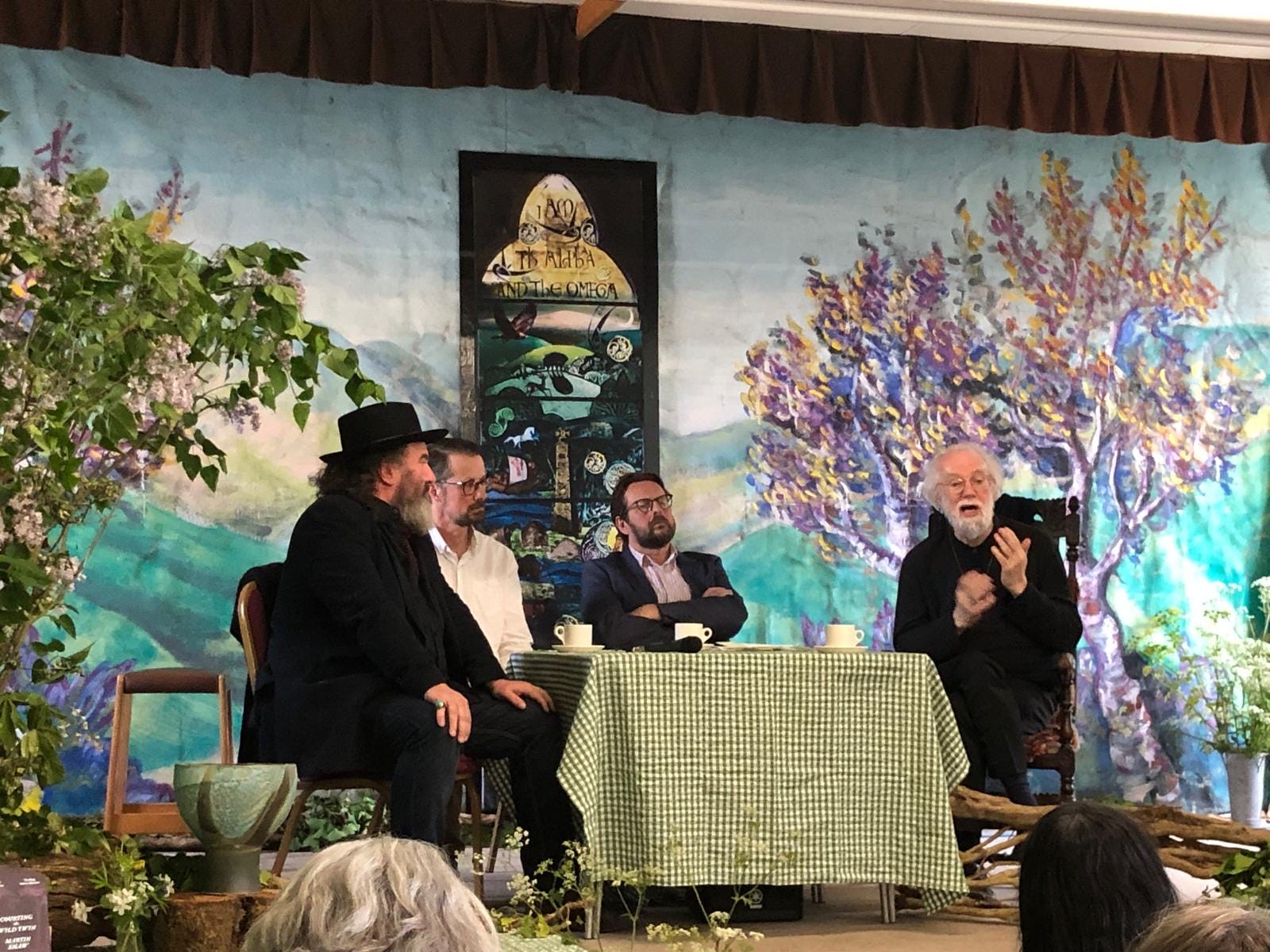
(L-R) Martin Shaw, Paul Kingsnorth, Marcus Plested, and Rowan Williams at the closing panel discussion.
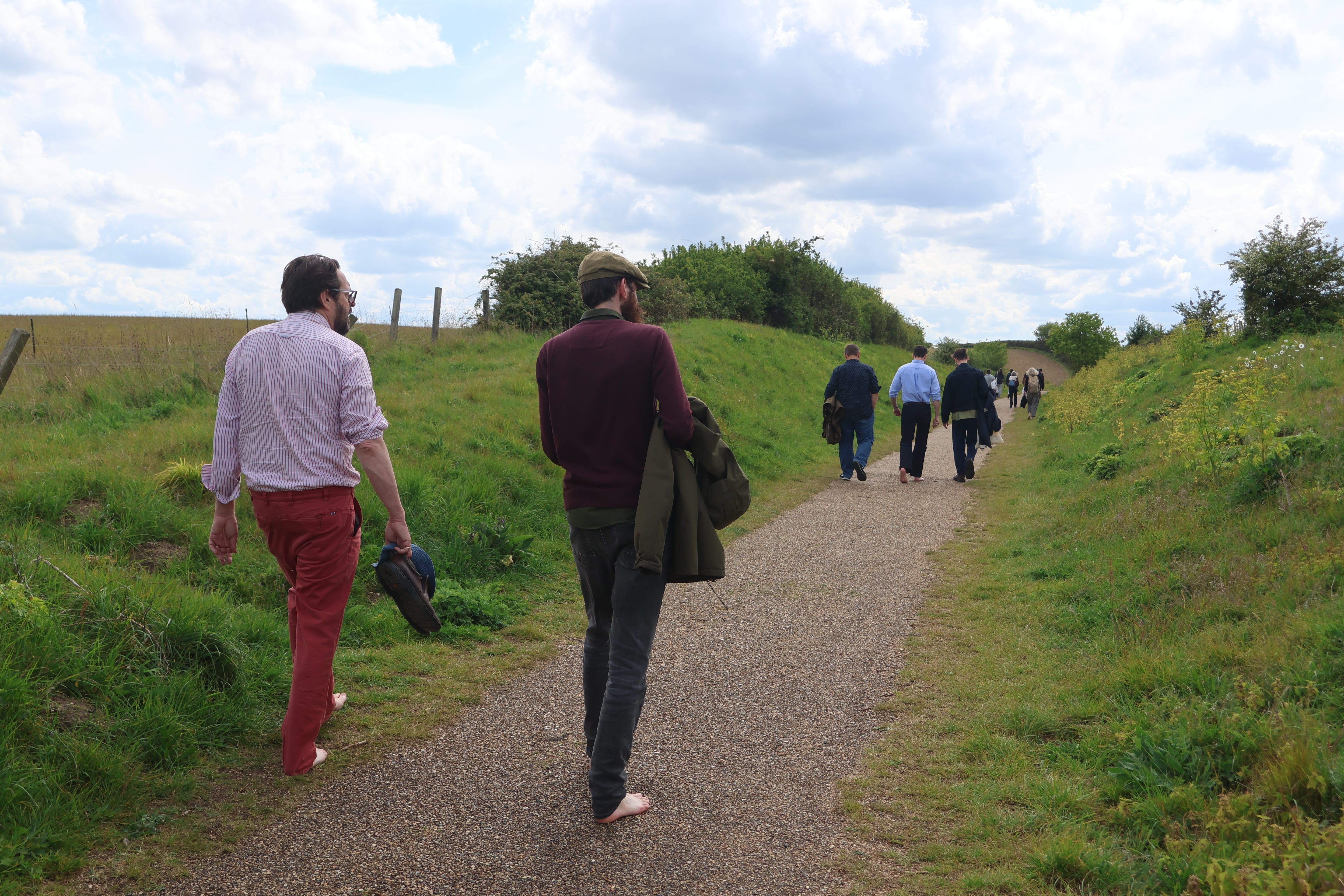
Our wonderful speakers —Paul Kingsnorth, Martin Shaw, and Rowan Williams — together with some brilliant artists and musicians — Ben MacDiarmid, Laura Huston, Georgina Finn, Susanna Cover, Benjamin Finn, and St Seraphim’s own Mariamni Plested — joined forces with a luminous array of helpers and splendid participants (many of whom had travelled great distances to attend — including an American couple on their honeymoon) to produce a quite extraordinary and grace-filled event. The convention concluded with a pilgrimage walk through Walsingham’s sacred landscape and along the Orthodox Holy Mile:
It’s too much in the exhaustion of the immediate aftermath to go into much more detail (more to follow, I trust) but in this post we want to offer a text that eloquently conveys the essence of what it was all about. One of the special joys of the conference was the opportunity to attend a beautiful set of services in St Seraphim’s. These were celebrated by Fr Alexis Torrance (of the University of Notre Dame) with the gracious blessing of His Eminence Archbishop Nikitas of Thyateira.
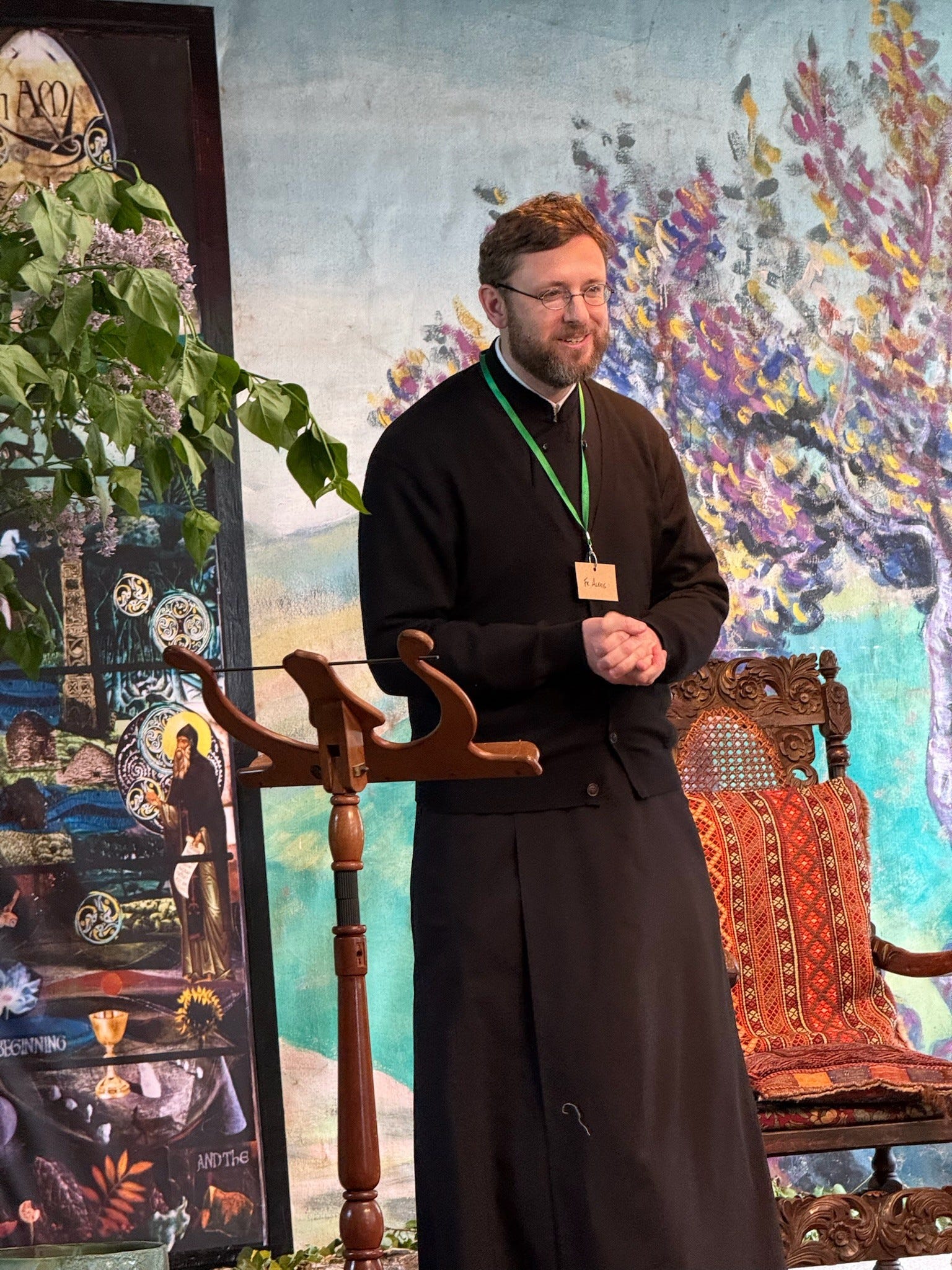
Fr Alexis introducing one of the speakers (with a limerick, no less!)
The homily Fr Alexis preached at the divine liturgy for the Sunday of the Blind Man summed up so well so many of the themes of the convention that we asked him if he would allow us to publish the text on ‘Orthodox Station’ — and in his very great kindness, he agreed. Here it is:
Beloved brothers and sisters in Christ:
Christ is risen!
The saints of God are seers of God: they see reality and truth with a clarity and precision that no corrective lens nor technological power of magnification can match. It is fitting, then, that as we reflect together on the saints of these lands we come together to worship and partake of the only truly holy one—the only saint—Our Lord Jesus Christ, on this commemorative Sunday of his healing of the man born blind. For the saints can only become such, can only become seers, if they participate in he who is Light itself, he who is holiness and sanctity itself. They must acknowledge their whole dependency upon him, ‘without whom they can do nothing’ (cf. John 15:5), without whom they cannot see. Otherwise their sin remaineth (cf. John 9:41). Our own sin remains, brothers and sisters, insofar as we think we can independently see, that we can see without the giver of sight. There is no independent vision, just as there are no independent saints. Vision and sanctity, seeing and holiness: this is our theme this morning.
The opportunity to bask in the light of the British saints, in their stories, their landscapes, their example, and their prayers, is not simply an opportunity to stimulate our minds or stir patriotic emotions in our breast. It is an opportunity for us to recover our own sight, individually and collectively, to see and judge ourselves by the light of the risen Christ and his saints, rather than by our own lights. It is an opportunity, in other words, for repentance. Repentance is the path to spiritual vision, brothers and sisters, the path to sanctity, the path to life.
Our Lord offers us the image of our recovery from blindness, our re-creation, through his healing of the man born blind. He forbids us all the while, however, from collapsing the physical into the spiritual or vice versa: ‘Neither hath this man sinned, nor his parents: but that the works of God should be made manifest in him’ (John 9:3). We cannot equate the two, the physical and spiritual, and we also cannot easily draw a line from one to the other. We cannot compute or calculate with our feeble minds the precise relationship between the state of the body and the state of the soul, though we affirm categorically the human person’s constitution as both, never fully known or realised as just one or the other. Soul and body are in an unbreakable relational bond from the moment of our conception, through our earthly life and even beyond our death—for separation does not necessarily destroy relationship—a relational bond consummated at our resurrection to come. It is no surprise, then, that Our Lord repeatedly illustrates lessons for our soul through bodily wonders, and why we as Christians rejoice at the advent of physical healing too, while always ascribing to the latter its proper place and secondary rank.
The refashioning of our vision, brothers and sisters, is a gift from God. It is the works of God being manifested in us. That is how saints are made. But how is the gift given? We are illuminated through Holy Baptism, wondrously and perfectly, even if, as the Fathers explain, we receive this grace in a hidden or mystical way (μυστικῶς), only to be realised or manifested actively (ἐνεργῶς) through abiding in Our Lord’s commandments. If we accept and know the gift of God, we petition him for living water. And what does he do? The Potter mixes spittle with clay and anoints our eyes, and we go and wash, and come seeing. In these actions we find together the type of our baptism and of our repentant striving to live out that baptism: the hidden and the manifest. We are reborn from on high as a pure gift, of water and the Spirit. But we learn from the blind man’s healing how to enact that gift. As we were first born from the dust of the earth that itself emerged from the waters, so the living out of our rebirth comes from the dust and clay of humility mixed with the water of repentant tears. We wash these hollowed out sockets, soften these adamantine hearts, with such waters of re-creation. Upon such waters the Spirit of God broods, activating that well of his grace within us, the baptismal gift, springing up into everlasting life.
The man born blind was healed swiftly, without increments. It can happen that when the baptismal gift is aligned with a will set aflame with love for Christ, the hidden and the manifest become virtually simultaneous. But, in general, we tend to receive our palpable healing slowly, gradually, incrementally. Yet we must not mistake the stages of healing with the ineffable destiny God desires for us. Like another healed of blindness in the Gospels, we may for a time ‘see men as trees, walking’ (Mark 8:24). We may see only obscurely, partially, perceiving things through the veil of stories. This too, is a gift of God. Our better stories are at best visions of this kind: partial, incomplete, always hiding something even as they reveal. They can ultimately become misleading if we simply stop at this stage; stop at the stories. Perhaps when we approach the British saints, through our own impoverished sight we see only ‘men as trees, walking’, we see them only, that is, as inspiring stories and myths and fables. But they are not like this. Our vision is impaired, not their reality. We rather are like trees, walking: unsure of what we are, and how we should be, by turns haltingly moving and staying still, simultaneously alive and dead. But the saints of Britain are children of the living, vibrantly and brilliantly conformed to the image of the Son.
Our gaze and desire must be fixed there, on their destiny and on attaining communion with them, if we are to proceed from partial healing to the fulness of vision. It is no use simply proclaiming as the possessed girl did in today’s epistle reading that ‘these men and women are servants of the Most High God, who proclaim to us the way of salvation’ (cf. Acts 16:17), but then mix this with lives unworthy or even inimical to the Gospel. This will only annoy the saints of Britain, as it did the Apostle Paul. They want imitators, not sycophants. They want our conversation to be in heaven, as theirs was and is, that grace might flow from there to here. As Christians we honour our homeland as we honour the body: in its proper place and secondary rank. When patriotic zeal becomes unhealthy, let us remember the admonition of St Gregory the Theologian, who wrote: ‘these earthly countries and families are the playthings of this our temporary life and scene. For our country is whatever each may have first occupied … and in this we are all alike strangers and pilgrims, however much we may play with names … I leave it to you to pride yourself on tombs or in myths, and I endeavour as far as I can, to purify myself from deceits, that I may keep if possible my nobility [namely, the nobility of the Divine Image], or else may recover it’ (Oration 33.12).
And when we risk the other extreme, and we abstract ourselves entirely from this land and place hallowed by the footsteps and bones of our forbears the saints, let us remember that the adjective in ‘British saints’ is not effaced simply because the weight of the noun is so much greater. We seek not the effacement of our natural characteristics, including our lands and homes, but their infusion with grace. We seek not their destruction, but their transfiguration and assimilation to the one whom we love, who makes all things new. And he grants this. As meek disciples of the meek Christ, the saints of Britain inherited the earth. They inherited this earth. It belongs to them. And thank God, traces of our recognition of that fact remain in our placenames and holy sites, but would that we acknowledged it more, not culturally only, but spiritually, existentially. Only then might we too become their fellow inheritors of this land in the ineffable meekness of Christ.
As we turn now to complete the Divine Liturgy, we are moving farther up and farther in to the habitation of the saints of Britain, the heavenly mansions of the righteous. They give us the bearings we need for the fullness of vision, in spirit and in truth. We turn to them because our souls are weary and our lives are sick. We want to be healed. We do not want to be affirmed in our sickness. If we wanted that, we could simply hand ourselves over to the contemporary whirlpool of limitless entertainment, including the latest captivating allure of our AI ‘assistants’. But we resist that allure. For artificial intelligence is blind, and merely generates blind people-pleasing echoes of humanity, derivations that are at once disincarnate and soulless, that is, with neither soul nor body, let alone eyes to see or ears to hear. They may have some utility, but they cannot heal or save. The saints, by contrast, see clearly, and in their bodies and in their souls, generate God-pleasing acts of visionary creativity. As bearers of grace, they are embodiments of cosmic and supra-cosmic healing. The reverberations of the saints of Britain ripple through time and space, backwards and forwards and side-to-side: ‘filling up that which is behind of the afflictions of Christ in their flesh for his body’s sake, which is the Church’ (cf. Colossians 1:24). They did not ‘catch’ something that naturally pulsates through a cleaner air of yore. They sanctified the air, this air, by shaking off the dust from their feet and mounting the Tree of the Cross, on behalf of all and for all. Only in that reality do we find the godly meaning and fulfillment of seeing ‘men as trees, walking’. We are called to be their heirs, beloved brothers and sisters in Christ, their imitators. We are summoned to see with their vision, and act with their resolve.
O All-Holy Lady of Walsingham, and all ye saints of Britain, seers of Christ, take up arms for us and with us and in us, that divine glory may once more reign in these lands. Become for us living labourers in this precious vineyard, for we labourers are now so few, and so pitiable, and behold, the fields are whiter far to harvest than perhaps even the angels can perceive. Help us!
By their intercessions, may we recover our own sight and preach—even if only by the power of a good example—a like recovery throughout these lands, and to the ends of the earth. Amen.
Christ is risen!
— — — —
He is risen indeed!
Sincere thanks once again to Fr Alexis for sharing his sermon with us.
It was such a joy, and such a lively balance of many nourishing things. Onwards!
What a blessed and joyful weekend. Thank you.